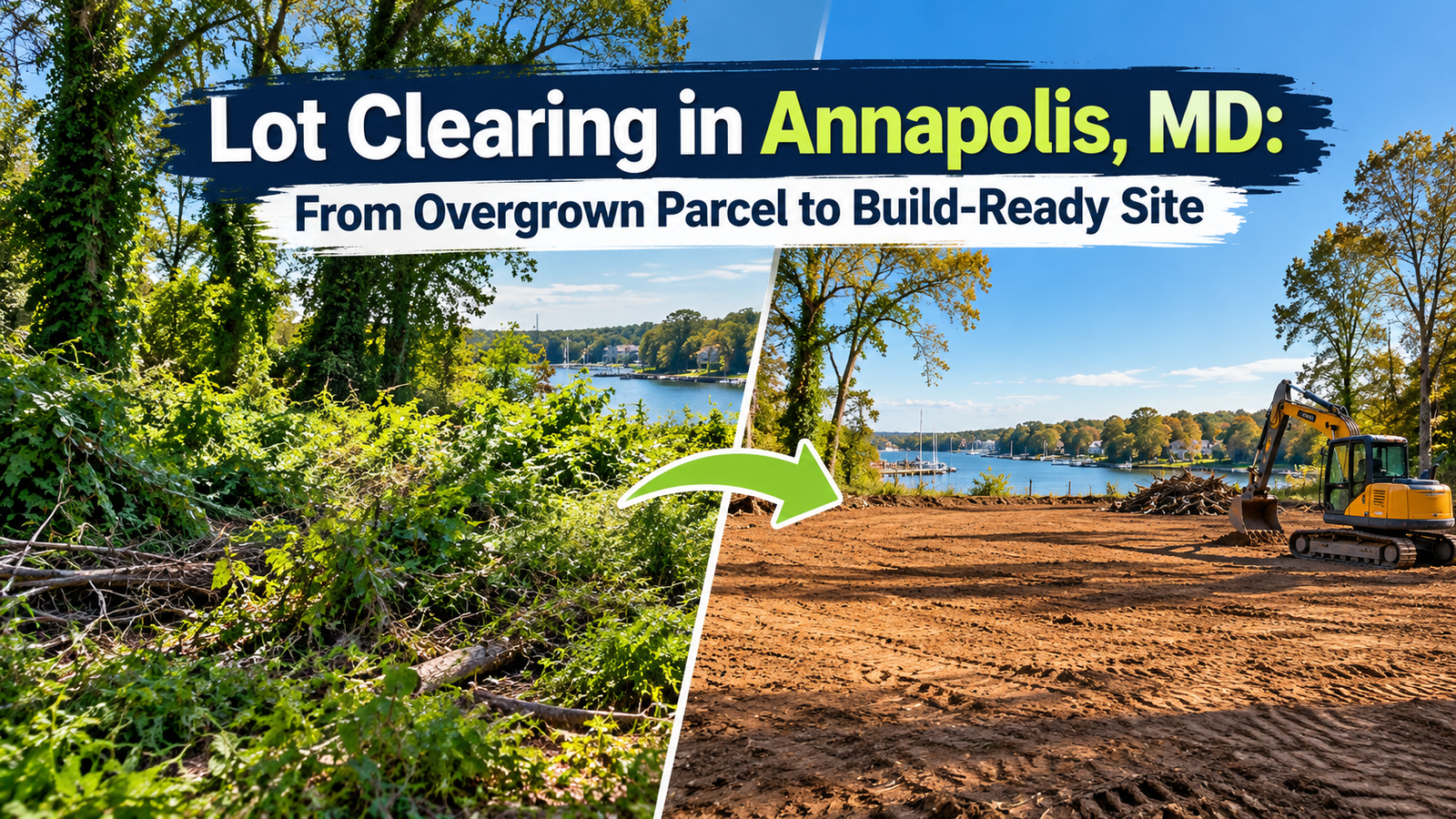
Lot clearing in Annapolis involves removing vegetation, debris, and surface obstacles from a parcel in preparation for construction or other use. In this city where the Chesapeake Bay watershed, tidal wetlands, dense urban canopy, and historic district protections all converge lot clearing Annapolis is subject to more regulatory oversight than in most Maryland jurisdictions. A project that might require only a grading permit in another county can require multiple agency approvals in Annapolis before a single tree is cut.
Lot Clearing Scope and What It Involves
Lot clearing encompasses removal of above-grade vegetation trees, shrubs, brush, and ground cover along with surface debris, and may include stump removal (grinding or excavating stumps to a specified depth below grade) and grubbing (removing root systems from the cleared area). The extent of clearing and grubbing required depends on the planned use of the cleared area: building pads and paved surfaces require full grubbing to prevent settlement from decaying organics; landscaped areas typically require less aggressive root removal.
In the Annapolis context, lot clearing often involves significant mature tree canopy. The city’s established neighborhoods have decades of tree growth on residential lots, and infill development on vacant lots commonly encounters large specimen trees that require careful assessment before any clearing begins. Some of these trees may be subject to the City’s Tree Removal Permit requirements or to Forest Conservation Plan provisions; others may simply be large, healthy trees that careful project planning could retain.
Pre-Clearing Assessment: What Must Be Done First
Before any vegetation is removed from a lot in Annapolis or Anne Arundel County, several assessments and determinations must be made. First, the lot’s regulatory context must be established: Is it within the City of Annapolis limits or in unincorporated Anne Arundel County? Is it within the Chesapeake Bay Critical Area? Does it contain or adjoin wetlands? Are there forest areas that trigger Forest Conservation Act requirements? Is the lot within Annapolis’s Historic District, where tree removal may affect historic landscape character?
Wetland assessment is a critical first step for any Annapolis-area lot. The topography and drainage patterns of the Coastal Plain landscape mean that wetlands can exist on parcels that appear relatively upland. A wetland determination even a preliminary desktop review using National Wetlands Inventory data and county GIS mapping can identify the probability of regulated wetlands before committing to a site plan that assumes open clearing.
Utility marking through Miss Utility (811) must be completed at least 48 hours before any clearing equipment begins grubbing or stump removal. Although overhead utility conflicts are sometimes obvious, underground utilities including private utilities serving adjacent properties may not be apparent until equipment is in the ground. Clearing equipment that strikes a utility line can cause injury, service outages, and significant liability.
Protecting Adjacent Trees and Vegetation During Lot Clearing
Clearing a lot while protecting trees on adjacent properties requires planning and physical barriers before equipment enters the site. Tree root zones extend well beyond the visible drip line the radius of protection should be at least 1 to 1.5 feet for every inch of trunk diameter. Equipment operating within the root zone of a retained tree compacts soil, severs roots, and damages feeder roots, often causing the tree to decline over the following one to three years even if it appears unharmed immediately after clearing.
Tree Protection Zones (TPZ) should be physically established with orange construction fencing or wooden stakes and flagging before any clearing equipment moves through the site. Clearing contractors should understand the TPZ boundaries and maintain them throughout the project. In Annapolis, where tree canopies routinely extend across property lines and neighbor trees are often within feet of lot clearing activity, this protection is both ethically and legally important.
Root pruning cutting tree roots cleanly with a saw or root saw at the edge of the clearing area rather than tearing them with a dozer or excavator reduces injury to retained trees. Clean root cuts heal more effectively than torn roots and reduce the entry point for wood-decay fungi. On projects where significant root zone encroachment is unavoidable, consulting with a certified arborist before clearing begins can help minimize long-term impacts to neighboring trees.
Stormwater and Erosion Control During Lot Clearing
Annapolis’s position in the Chesapeake Bay watershed means that sediment from cleared lots has downstream consequences sediment that reaches Spa Creek, the Severn River, or their tributaries contributes to water clarity and water quality problems in the Bay. Maryland’s erosion and sediment control standards require that controls be installed before clearing begins and maintained throughout the project.
For lot clearing above 5,000 square feet of disturbance, an Erosion and Sediment Control Plan approved by Anne Arundel County’s Soil Conservation District is required. For smaller disturbances, controls are still required even without a formal plan. The basic control package for a lot clearing project in Annapolis includes silt fencing along the downhill and waterward perimeter of the disturbance, inlet protection on nearby storm drains, and a stabilized construction entrance where equipment accesses the site.
Particular attention to erosion control is needed near any drainage features natural channels, swales, or stormwater infrastructure that flow toward tidal waterways. A single significant rain event on an unprotected cleared lot can produce sediment loadings that trigger MDE investigation and enforcement.
Topsoil Handling and Site Restoration After Clearing
Topsoil stripped during lot clearing should be stockpiled separately for reuse in final landscaping. Anne Arundel County’s soils have good organic matter content in the A horizon particularly in the wooded lots common in Annapolis’s established neighborhoods and this material has real value as finished topsoil for planting areas. Stripping it separately and protecting the stockpile from erosion preserves a resource that would otherwise need to be purchased and imported at project close-out.
After clearing and any required grubbing, the lot must be stabilized promptly. Maryland’s sediment control standards require temporary stabilization within 14 days for areas that won’t be actively worked. In Annapolis’s wet climate, this typically means applying straw mulch or hydroseed to exposed soil within that window. Areas that will be graded for construction can remain as stabilized rough grade pending the next work phase.
For lots in the Critical Area where clearing has disturbed the vegetative buffer, restoration planting of native species may be required as part of the clearing approval. Native plantings specified in the Critical Area management plan must be installed during the appropriate planting season typically fall or early spring for best establishment which may not align with the construction schedule. This sequencing issue should be anticipated and planned for before clearing begins.
Frequently Asked Questions: Lot Clearing in Annapolis
What permits are needed to clear a vacant lot in Annapolis?
Required permits depend on the lot’s size, location, and regulatory context. Tree removal within city limits typically requires a Tree Removal Permit from the City of Annapolis. Disturbance above 5,000 square feet requires an approved Erosion and Sediment Control Plan from Anne Arundel County’s Soil Conservation District. Lots in the Critical Area require review by the county’s Critical Area program. Lots near or containing wetlands may require MDE and Army Corps permits. A pre-application meeting with the City’s planning department is the recommended starting point.
Does lot clearing in Annapolis require a wetland delineation?
On any lot where wetlands may be present indicated by low-lying areas, drainage patterns, or proximity to streams, ponds, or tidal water a wetland delineation by a qualified professional is strongly recommended before clearing begins. Clearing regulated wetlands without permits violates state and federal law and can result in mandatory restoration orders and significant fines. The cost of a delineation is modest compared to the potential cost of unauthorized wetland impact.
How does the Forest Conservation Act apply to lot clearing in Anne Arundel County?
The FCA applies to development projects disturbing more than 40,000 square feet on sites with more than 10,000 square feet of forest. For standard residential lot clearing below these thresholds, the FCA’s plan requirement may not apply, but the City of Annapolis’s tree removal ordinance and Critical Area requirements still do. For larger clearing projects subdivision development, commercial site preparation the FCA plan requirement almost certainly applies, and a licensed forester must prepare the Forest Stand Delineation and Forest Conservation Plan.
Can stumps be left in the ground after lot clearing in Annapolis?
Stump treatment after clearing depends on the planned use. Building pad areas and paved surfaces require complete stump and root removal to prevent settlement from decaying organics. Areas that will be graded and landscaped may have stumps ground to several inches below final grade. Areas far from structures may have stumps left in place if they are not in the path of drainage or utility infrastructure. The geotechnical engineer’s specifications or the civil engineer’s grading plan typically specify stump removal depth for each area of the site.